Every number tied out before anyone acts on it.
Operators lose hours reconciling numbers that never agree. Mirus collects every system you run, ties it out against the source, keeps it current as your business changes, and puts it in front of anyone who needs a number.
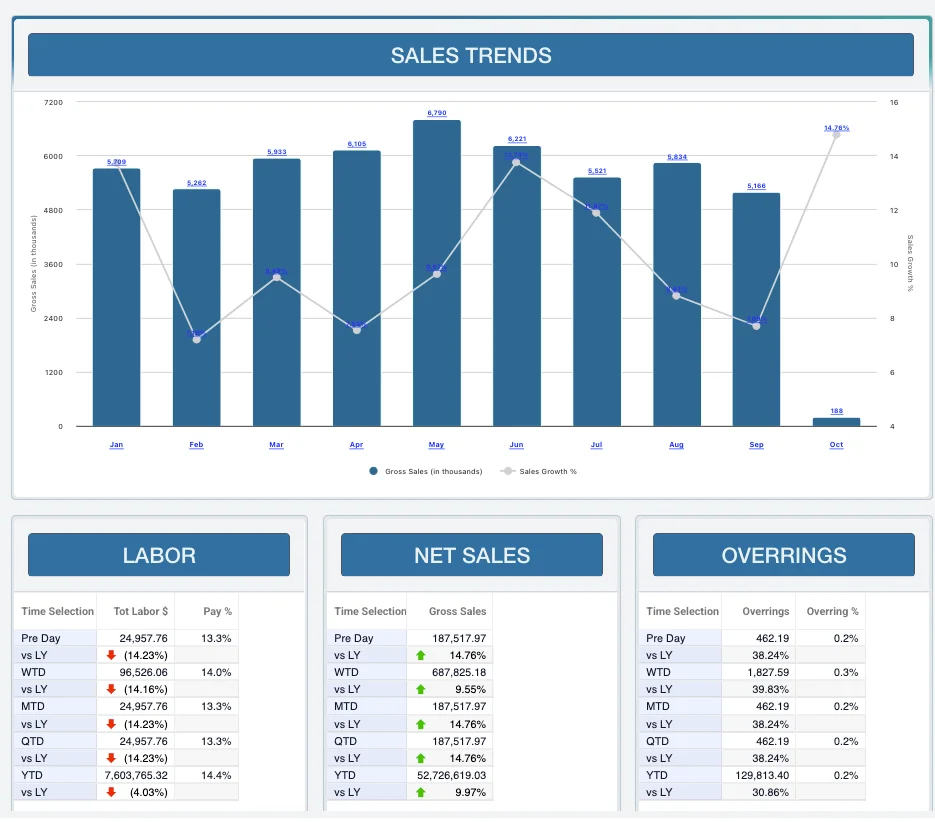
Four modules, one warehouse underneath.
- THE COREMirus Enterprise
Your data warehouse and the report writer over it. Every other module reads the same reconciled data.
- EXCEPTION-BASEDDashboards and alerts
Set a threshold once and every exception is flagged for you, naming the unit and the size of the gap.
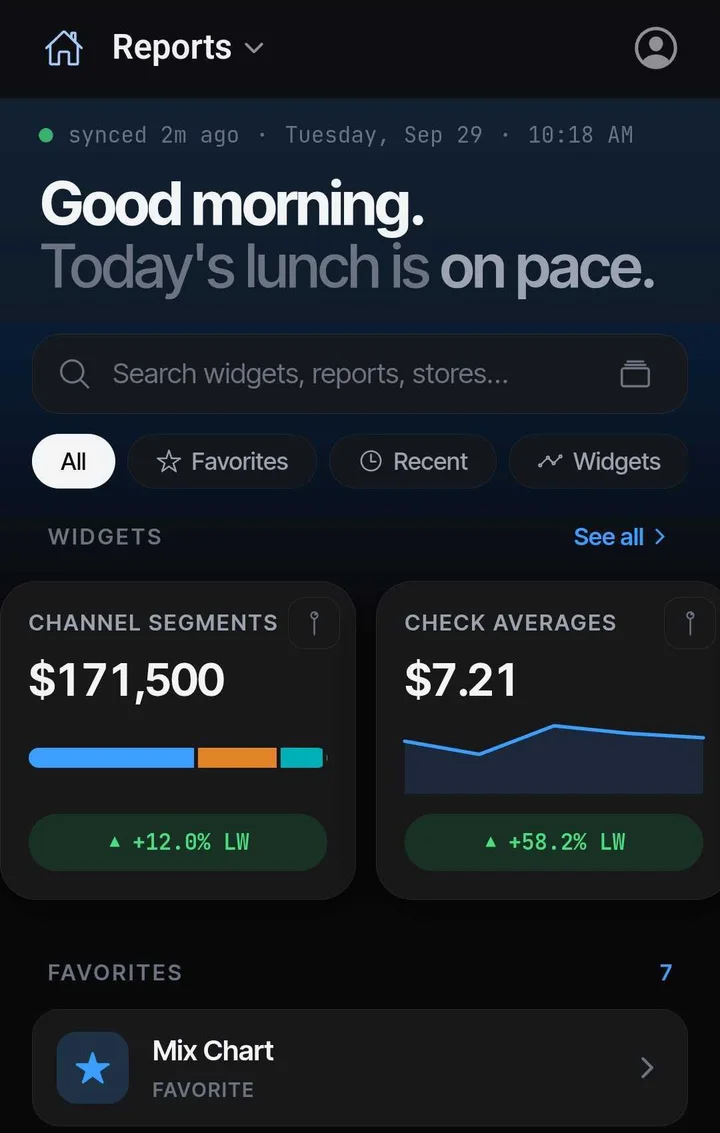
- IOS AND ANDROIDMirus Mobile
The same reports and alerts against the same warehouse, on the drive between units.
- LIMITED RELEASEMira
Our AI. Ask a question about the report in front of you in plain language, and get the answer back.
One warehouse, built for your estate.
- One warehouse per client.
- Not a shared schema: your feeds, your mappings, your history.
- Any source, any format.
- POS, labor, inventory, loyalty, ordering, invoices and accounting.
- Years of detail.
- At least 12 months of transaction-level history from day one, building to five years.
- Yours to take.
- Export it, or take it with you. There is no fee to access it.
Three ways in, whichever the source allows.
Installed behind your firewall, polls the source and pushes on a schedule.
Vendor or store drops a file; Mirus collects, validates and loads it.
Mirus calls the vendor API where one exists, on your credentials.
- Update frequency
- Updated several times an hour, wherever the source system allows.
- Time to post
- Usually posted within the hour
A number nobody argues with.
Validation is not a checkbox at the end of a load: it is a joint process with your team, and it produces a report you can re-run.
- 01Internal validation
Row counts, control totals and schema checks before anything is posted.
- 02Joint verification
Mirus and your team compare the loaded data against the source system, feed by feed.
- 03Tie reports
A like-for-like report against the source system, so the match is provable and repeatable.
Your estate changes. The reporting keeps up.
Store master file, dimensions and the retail calendar are maintained as units open, close, remodel and change concept.
| Unit | Name | Region | Status | ||
|---|---|---|---|---|---|
| 0011 | Gulf Freeway | Gulf Coast | QSR | 2014-06-02 | Open |
| 0042 | Westheimer | Gulf Coast | QSR | 2016-11-14 | Open |
| 0107 | Northline | North | Fast casual | 2019-03-25 | Open |
| 0155 | Grand Prairie | North | Fast casual | 2021-08-09 | Remodel |
| 0208 | Rio West | West | QSR | 2023-01-30 | Open |
| 0231 | Airport Way | West | QSR | 2024-05-06 | Closed |
Anyone can build the report they need.
No coding, on any device, against the same warehouse the standard reports run on.

- 50+
- Standard reports
- Unlimited
- Custom reports, dashboards and alerts
- No coding
- Required to build one
- Any device
- Desktop, tablet, phone
Nobody reads every report.
Set a threshold once and every exception is flagged for you, naming the unit and the size of the gap.
The same numbers, on the drive between units.
Mirus Mobile runs the same reports and alerts against the same warehouse: a district manager opening a link on a phone gets the figure, not a desktop layout squeezed down.
Mira
Ask the warehouse a question in plain language. Mira runs on your integrations and your business rules, and is in limited release with a small group of clients.

A question about the report in front of you, answered without building a new one.
Comparisons and calculations the report layer cannot express on its own.
Mira reads the report you are viewing, so it works from data that has been reconciled to your source systems.
Questions evaluators ask
See it against your own systems.
A scoped demo built on your POS, labor and accounting feeds: not a generic walkthrough.